Showing posts with label Trevor Dickinson. Show all posts

John Robson of Climate Discussion Nexus Share Causes of Urban Flooding - Highlights CBC Ombudsman Findings on 100-Year Storms

This blog has examined causes of urban flooding and non-causes of flooding too. A new video by the Climate Discussion Nexus examines causes of urban flooding and references the recent CBC Ombudsman review of 100-year storm trends (i.e., no changes in extreme rainfall).

https://climatediscussionnexus.com/videos/urban-flooding-its-not-about-climate/


The video notes that we have always had flooding which is correct - that is something we have noted as well, like in this presentation to the WEAO / OWWA joint climate change committee: https://www.slideshare.net/RobertMuir3/infrastructure-resiliency-and-adaptation-for-climate-change-and-todays-extremes

The presentation noted how GO Train flooding, Toronto Island flooding and Toronto basement flooding area note new phenomena as shown in these images:


A review of the inquiry for Premier Davis on Toronto Don River flooding noted flooding since the 1800's as noted in this post: https://www.cityfloodmap.com/2015/07/go-train-flooding-not-new-1981-inquiry.html - an Environmental Assessment in 1983 noted this:


This Acres Consulting report noted the influence of hydrologic changes on peak flows and flood damages. We have described these changes as well such as in this JWMM paper: https://www.chijournal.org/C449

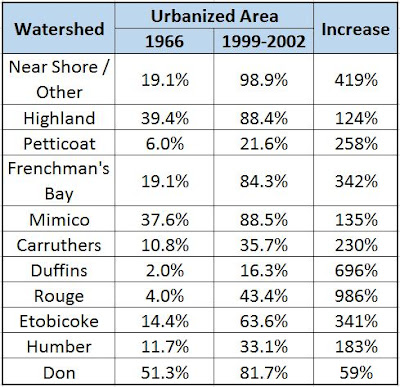
GTA watershed urbanization changes were summarized as follows:


Here is a wider perspective:
And here are urbanization trends in other southern Ontario municipalities: https://www.cityfloodmap.com/2016/08/land-use-change-drives-urban-flood-risk.html

We have assessed the trends in extreme rainfall which supported the CBC Ombudsman decision - here are the english-version findings: https://www.cityfloodmap.com/2019/06/office-of-ombudsman-french-services.html

Even Minister McKenna has reinforced comments made in Canada's Changing Climate Report stating in a June 2019 letter "the observational record has not yet shown evidence of consistent changes in short-duration precipitation extremes across the country":
https://www.cityfloodmap.com/2019/06/canadas-minister-of-environment-and.html

Other CBC story corrections about extreme rainfall are summarized here: https://www.cityfloodmap.com/2019/06/cbc-correcting-claims-on-extreme.html

As the Climate Discussion Nexus video notes, the insurance industry has claimed that there is an increase in extreme rainfall caused by climate change - this has been reiterated by senior executives as in this op-ed in the Globe and Mail by Charles Brindamour and Dean Connor "Climate resilience must be part of every government’s agenda" (The Globe and Mail. September 25, 2018. https://www.theglobeandmail.com/business/commentary/article-climate-resilience-must-be-part-of-every-governments-agenda/), or as in this op-ed in the Financial Post by Craig Stewart "Counterpoint: Insurance claim costs are rising because severe weather is making flooding worse" (Financial Post. February 7, 2019. https://business.financialpost.com/opinion/counterpoint-insurance-claim-costs-are-rising-because-severe-weather-is-making-flooding-worse).

Unfortunately, the insurance industry has not ever offered any data on increasing extreme weather trends to counter Minister McKenna's recent statement or the CBC Ombudsman findings since 2015. The insurance industry has in the past mixed up future predicted extreme rain trends with past observations as in the "Telling the Weather Story" report:


As noted in our Financial Post op-ed, the insurance industry has claimed a correlation and causation between extreme weather and flood damages. Unfortunately, there is no rain trend to correlate to making any causation discussion moot. As Dr. Dickinson explains in the video, warmer winters mean lower spring flood potential, and urbanization drives urban flood stresses, not changes in rainfall. More on this University of Guelph analysis is here:


Our rebuttal to the insurance industry's suggested correlation / causation was in the Financial Post: https://business.financialpost.com/opinion/hyped-up-misleading-insurance-myths-about-severe-weather-flooding-distract-us-from-real-problems

Well done John Robson and Climate Discussion Nexus for sharing information on this topic.

***

More reading? - what do engineering studies in southern Ontario say about extreme rainfall trends? typically no past change - see compiled reports / analysis here: https://www.cityfloodmap.com/2018/03/extreme-rainfall-and-climate-change-in.html

The Ombudsman has also recently noted in a new review that "It would have been wrong to state categorically that Canada has already seen an increase in extreme rainfall events" and that its reporting should be unambiguous about the past, present and future, with "distinctions made between observed phenomena and predicted phenomena" (https://www.cityfloodmap.com/2020/05/past-present-or-future-cbc-ombudsman.html).  The Ombudsman notes that CBC reporting describes future changes in extreme weather saying:
  • Canada is warming at twice the global rate, and our north is warming at three times that rate.
  • We can expect more extreme heat, warmer winters, earlier springs and rising sea levels.
  • Precipitation will increase in much of the country.
  • Weather extremes will intensify.

  • The last two bullet points are careful to use the future tense.

University of Guelph Research Shows Lower Spring Flooding With Global Warming, No Change in Rainfall, and Explains Urban Flooding Due to Urbanization - Not Climate Change Effects

Research from the University of Guelph has shown that climate change has reduced spring flooding risk (exponential growth in frost-free days with more recharge and less snow pack / spring melt) and that summer flow changes are due to urbanization, not changes in precipitation.

The presentation below summarizes the research and is entitled "Disentangling Impacts of Climate & Land Use Change on Quantity & Quality of River Flows in Southern Ontario" - the authors, Trevor Dickinson and Ramesh Rudra from the University of Guelph clearly see the need to clarify drivers for flow changes and to avoid the common media mistake of associating all extreme hydrologic conditions with climate change and omitting changes that may lower risks (like spring flooding in some watersheds).


Research indicates:
1) Monthly and Annual Precipitation has remained unchanged (see slide 7)
2) Temperatures have risen 'mostly in the winter' (see slide 13 - 14), meaning summer maximum temperatures that are typically associated with extreme rainfall have not increased, or have decreased
3) Extreme daily maximum temperatures have decreased (slide 14)
4) Increased winter temperatures mean more steady winter runoff, more infiltration and "Decreased Snowmelt Floods" (see slides 24 - 31)
5) Urbanization increases runoff coefficients (slide 36-37) and:

" So … in Ontario urban watersheds: - urban development has augmented the winter and spring climate change impacts; and - summer flow volumes have increased dramatically, in volume and frequency, these impacts being completely due to urban development."

The big take away is that urbanization is a key driver for summer river flows in Southern Ontario, but climate change is not - this is supported by trends in the Engineering Climate Datasets (version 2.3) that show twice as many statistically significant decreasing Southern Ontario trends as increasing ones.

This analysis is consistent with review by others showing change in minimum temperatures but no change in summer maximum temperatures. For example, the Ontario Centre for Climate Impacts and Adaptation Resources reviewed climate change trends for several stations - for Ottawa airport, between 1939 and 2014, the average winter minimum is up by 2.5 degrees Celcius and average winter mean is up 2.2 degrees. But the summer maximum is flat - no change. While the summer mean temperature is up by 0.5 degrees, this is due to increases in minimum temperatures, which were up by 1.1 degrees. These graphs from the Centre show the difference in winter temperatures changes and summer temperatures changes:

Winter temperatures have increased with climate change - Ottawa, 1939-2016

Summer maximum temperatures (middle chart) have NOT increased with climate change - Ottawa, 1939-2016. Changes in mean temperature are driven by changes in minimum temperatures.
Those who point to the Clausius-Clapeyron equation and a greater water vapour holding capacity at higher temperatures as a driver for climate change-induced flooding in urban areas should reevaluate their position, and consider the data on maximum temperatures. Since there is no increase in summer maximum temperature at some stations, the cause of flooding due to extreme rainfall cannot be greater water vapour holding capacity of the air - as research at the University of Guelph has shown, urbanization and not climate change is the key driver for changes in river flow. We can expect the same types of flow impacts beyond river systems and within municipal infrastructure systems, where urbanization and intensification have increases hydrologic stresses on systems even with no change to rainfall inputs.

The Ontario Centre for Climate Impacts and Adaptation Resources reviewed climate change trends for Hamilton as well. The following charts show the same relative temperatures changes as Ottawa:
Hamilton winter temperature has increased the most due to climate change.

Hamilton summer temperatures have increased at only a fraction of the winter increase.
 The Hamilton summer maximum temperatures increase (0.4 degrees in 40 years from 1970 to 2010) is only a fraction of the winter maximum increase (1.8 degrees in 40 years). The 0.4 degree increase in summer maximum would translate into less than a 3% change in water vapour holding capacity over 40 years. A review of research in another post has shown that temperature increases have not resulted in extreme rainfall increases across Canada - see post here.

Urbanization has increased significantly in Southern Ontario since the mid 1960's as shown in this post - this includes Hamilton growth:


In the Toronto area, where the University of Guelph assessed changes in runoff and linked these to urbanization as opposed to climate change, growth has also been significant since the mid 1960's. The following table shows changes in Toronto-area watersheds where urbanization increased from 59% to 986% over a perido of about 35 years. Compared to theoretical temperature-induced water vapour changes changes of a few percentage, if any at all, urbanization clearly explains higher runoff stress and flood risk while climate change explains none of the risks.

Urban Growth in TRCA watersheds and Flood Risk Influence on Urban Flooding

Greater Toronto Area Urban Area Growth in TRCA watersheds and Flood Risk Influence on Urban Flooding